Five occupations, one funding question, and no honest shortcut
The question arrives before the evidence is ready:
Which advanced-manufacturing occupations deserve employer validation before training funds are allocated?
Five occupations are already on the table:
- Industrial Engineers;
- First-Line Supervisors of Production and Operating Workers;
- Machinists;
- Welders, Cutters, Solderers, and Brazers;
- Industrial Machinery Mechanics.
There is employment data. There are wage estimates. There are task and skill profiles. There are industry hiring and separation figures. Every source looks useful.
The tempting next step is to combine everything into a score and rank the five occupations.
That would be fast. It would also imply more than the evidence can support.
The public AvelinLabs Connecticut fixture takes a different path. It produces a Workforce Evidence Pack: a deterministic, source-traceable package designed to help a buyer decide what should be validated next—not to manufacture an investment recommendation.
The decision gap
Section titled “The decision gap”Workforce decisions often begin with data abundance and end with an accountability gap.
A spreadsheet can show that an occupation has 6,020 workers in Connecticut. An occupation profile can list core tasks. Industry-flow data can show hires and separations in a manufacturing industry. None of those facts, alone or combined casually, proves that a regional training investment will work.
The missing questions are operational:
- Are employers actually struggling to hire or retain the role in the target locations?
- Which tasks must new workers perform within 30, 60, or 90 days?
- Which skills are entry requirements, and which can be trained?
- What credentials, equipment, and safety requirements are mandatory?
- How many hires or incumbent workers would justify a program?
- Who is accountable for validating the conclusion?
The value of an Evidence Pack is not that it removes these questions. It makes them impossible to ignore.
Three official sources, three different populations
Section titled “Three official sources, three different populations”The Connecticut example packages three governed evidence families:
| Evidence family | What it contributes | Boundary preserved by the pack |
|---|---|---|
| OEWS | Occupation employment and wage evidence | Does not establish employer demand or training viability |
| O*NET 30.3 | Governed occupation tasks and essential skills | Does not describe one employer’s local operating requirements |
| Census QWI | Separate industry employment, hires, separations, and net job change | Industry rows are never attributed to individual occupations |
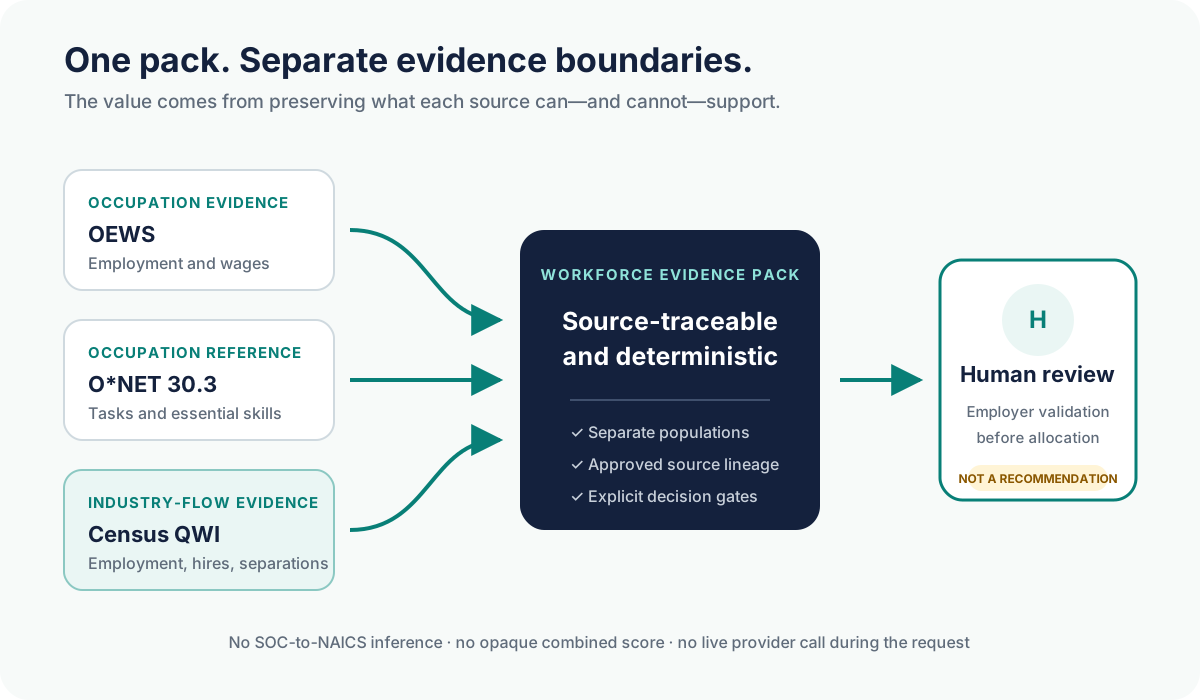
The sources are complementary, not interchangeable. The Pack preserves the boundary instead of hiding it inside an opaque score.
This separation matters because SOC, O*NET-SOC, and NAICS classify different things. AvelinLabs does not infer an industry from an occupation code and does not attach QWI industry flows to a specific role.
A concrete Connecticut request
Section titled “A concrete Connecticut request”The public fixture is intentionally narrow: United States, Connecticut, English, two manufacturing industries, and five occupations.
{ "country_code": "US", "region": { "type": "state", "code": "CT" }, "decision": "workforce_investment", "industries": ["311", "334"], "occupations": [ "17-2112", "51-1011", "51-4041", "51-4121", "49-9041" ], "language": "en"}Inspect the canonical request on GitHub.
The narrow scope is a feature. The API does not treat a reusable renderer as proof that every geography has approved evidence available. Callers must check capabilities and the requested boundary first.
What the buyer receives
Section titled “What the buyer receives”The accepted static fixture turns the request into an account-scoped JSON document and a standalone HTML buyer report.
The report does not rank the occupations. It presents them as an unranked validation cohort with occupation evidence cards and a next decision: conduct bounded employer validation before selecting occupations or allocating funds.
The fixture includes these reviewed OEWS values:
| Occupation | CT employment | Annual mean wage | Decision status |
|---|---|---|---|
| Industrial Engineers | 6,020 | $109,190 | Validate locally |
| Production and Operating Supervisors | 9,150 | $85,810 | Validate locally |
| Machinists | 5,240 | $64,030 | Validate locally |
| Welders, Cutters, Solderers, and Brazers | 1,790 | $66,800 | Validate locally |
| Industrial Machinery Mechanics | 2,360 | $72,230 | Validate locally |
The same report presents QWI rows separately. For NAICS 311 and 334, the fixture shows industry-level employment, hires, separations, and net job change. Those figures provide industry-flow context; they are not evidence that any one of the five occupations caused the movement.
Open the buyer-facing Connecticut report fixture.
The report is a public renderer reference based on a controlled fixture. It is not a live API response, a production observation, or evidence of arbitrary-country availability.
The most valuable line is not a number
Section titled “The most valuable line is not a number”At the top of the report, the status is explicit:
BUYER REVIEW READY — Not an investment recommendation. Employer validation and regional evidence remain required.
This is the distinction many analytics products blur.
buyer_review_ready means the package is coherent enough to support a structured conversation. decision_readiness=not_ready means the evidence does not yet justify an investment choice.
The Pack therefore creates a useful next action without pretending to have reached the final answer.
Reproducibility is part of the product
Section titled “Reproducibility is part of the product”Evidence is easier to trust when the same request produces the same identifiable package.
The public example proves an order-independent lifecycle:
- discover Workforce API capabilities;
- confirm accepted SOC occupation identifiers;
- submit the canonical Connecticut request;
- submit an order-equivalent request;
- confirm the same
evidence_pack_idandcache_status=reused; - retrieve both JSON and standalone HTML.
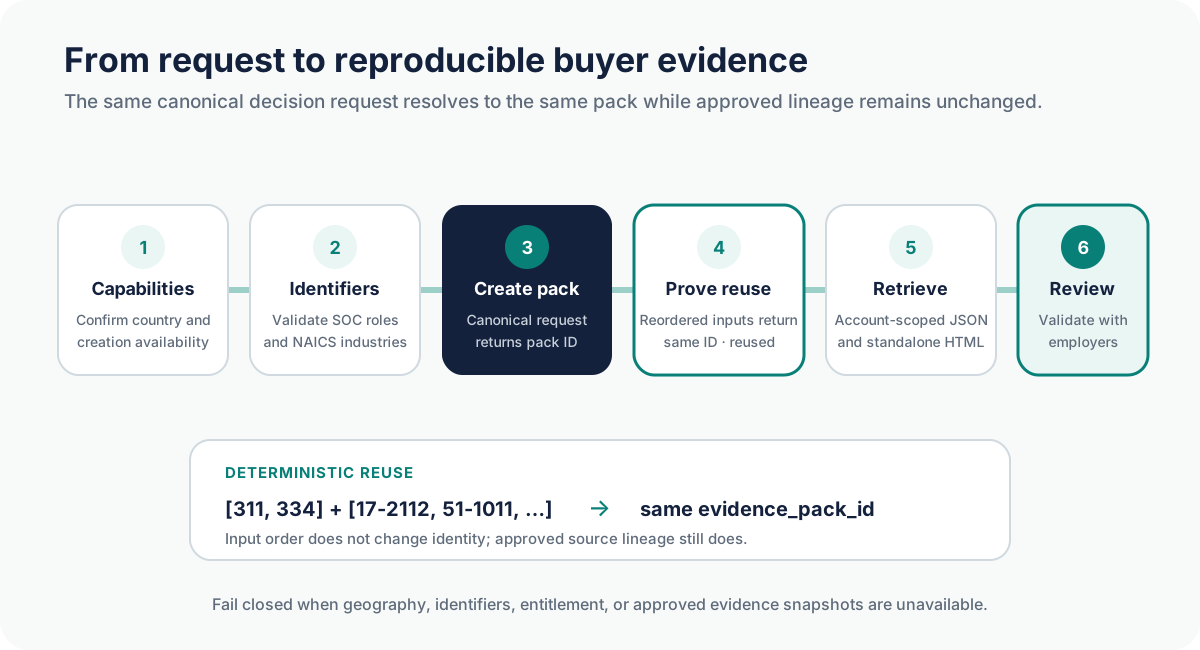
Reordering occupations or industries does not change the Pack identity. A change in approved evidence lineage still can.
The service packages approved normalized snapshots and governed reference data whose source IDs and raw checksums were approved beforehand.
That design protects the buyer from a report changing because a remote provider responded differently between two review meetings.
WHY this approach
Section titled “WHY this approach”The problem is not access to workforce data. The problem is converting heterogeneous data into a decision artifact without erasing provenance, population differences, or uncertainty.
A useful buyer package must do four things at once:
- make the evidence understandable without requiring the buyer to reconcile raw datasets;
- preserve enough lineage for a technical or policy reviewer to inspect it;
- state which conclusion the evidence supports today;
- state which conclusion it does not yet support.
The Evidence Pack treats those requirements as part of the output contract rather than explanatory notes added after the analysis.
WHY AvelinLabs
Section titled “WHY AvelinLabs”AvelinLabs is not positioning another dashboard as the decision.
Its role is the layer between governed workforce sources and the human workflow that must act on them:
- Source separation: occupation, industry, customer, and demand evidence keep their own meaning.
- Deterministic identity: an equivalent canonical request resolves to the same Pack while lineage is unchanged.
- Fail-closed boundaries: unsupported countries, geographies, identifiers, entitlements, or missing approved snapshots return explicit errors.
- Buyer and machine outputs: the same evidence can be retrieved as structured JSON and a standalone review report.
- Decision gates: readiness, missing evidence, and required review remain visible.
- Human accountability: the Pack recommends validation work, not automated funding or hiring action.
This is the practical meaning of a workforce decision layer: not replacing source systems or reviewers, but making the path between them traceable and usable.
WHY NOW
Section titled “WHY NOW”AI makes it inexpensive to summarize a large amount of workforce information. It does not automatically make the summary defensible.
As synthesis becomes faster, three risks become more important:
- Population mixing. Occupation and industry statistics can be combined into claims neither source supports.
- False freshness. A fluent answer can conceal when its data was captured, approved, or held back.
- Decision inflation. A useful research signal can be presented as a recommendation before local validation exists.
The response is not to slow every analysis down. It is to make evidence boundaries, deterministic inputs, and review gates part of the automated workflow.
That is why this pattern matters now: the cost of generating an answer is falling, while the need to demonstrate why the answer deserves action is rising.
Run the public lifecycle
Section titled “Run the public lifecycle”The Workforce Evidence Pack example repository includes:
- the canonical Connecticut request;
- Python and native PowerShell workflows;
- cURL commands for capabilities, occupation help, creation, JSON retrieval, and HTML retrieval;
- deterministic cache-reuse checks;
- the accepted static buyer report fixture.
The expected gate requires the workflow to confirm creation availability, find SOC 51-4121, prove order-independent reuse, and retrieve both output formats.
For the complete API contract, availability boundary, identifiers, and safe errors, see the Workforce Evidence Pack API documentation.
The answer the Pack is designed to give
Section titled “The answer the Pack is designed to give”The five occupations do not emerge as a synthetic ranking.
They emerge as five evidence-backed hypotheses that a buyer can take into an employer-validation workshop:
- Which roles are truly difficult to hire or retain?
- Which listed tasks matter locally?
- Which skills must exist on day one?
- Which outcomes would make training worthwhile?
- What additional evidence is required before money moves?
That may look less decisive than a score.
It is more useful because it tells the buyer what is known, what is not, and what responsible action comes next.