From Texas workforce data to local semiconductor training decisions
Texas can show the scale of an occupation. It cannot, by itself, tell a Central Texas workforce board which training program deserves funding.
That distinction is the starting point for this worked scenario.
The decision is not:
Which occupation should receive training investment?
The decision is narrower and more responsible:
Which occupations should advance to local employer and provider validation before training funds are committed?
The AvelinLabs Workforce Evidence Pack organizes the evidence needed for that decision without turning different data populations into an opaque score.

Five occupation hypotheses move through separate evidence streams toward a human-reviewed decision—not an automated ranking.
A five-role validation cohort
Section titled “A five-role validation cohort”The illustrative Texas scenario starts with five occupations that may be relevant to semiconductor manufacturing and its supporting operations:
| Occupation | Texas statewide employment | Annual mean wage |
|---|---|---|
| Electronics Engineers, Except Computer | 9,520 | $137,760 |
| Industrial Engineers | 30,980 | $114,840 |
| Electrical and Electronic Engineering Technologists and Technicians | 8,960 | $73,620 |
| Industrial Machinery Mechanics | 56,950 | $65,940 |
| Inspectors, Testers, Sorters, Samplers, and Weighers | 56,390 | $51,370 |
The values are statewide context from the approved OEWS snapshot used for the scenario. They do not establish current demand in Central Texas, prove a shortage, or justify a training investment.
The five roles are therefore an unranked validation cohort. Each role carries a caller-supplied program hypothesis explaining why it may matter—for example, production-system design, electronic testing, equipment maintenance, or quality inspection. Those hypotheses remain explicitly marked as requiring local validation.
Four evidence layers, four different questions
Section titled “Four evidence layers, four different questions”A responsible decision keeps each evidence family inside its proper boundary.
| Evidence layer | Question it helps answer | What it does not prove alone |
|---|---|---|
| BLS OEWS | How large is the occupation, and what does it pay? | Local employer demand, hiring difficulty, or training viability |
| Census QWI | What employment, hiring, and separation flows exist in the industry? | Which occupation produced those industry flows |
| O*NET 30.3 | What tasks and skills characterize the occupation? | One employer’s equipment, process, or entry requirements |
| Local validation | What do employers, providers, and the program owner confirm? | Nothing until the responsible party records the evidence |
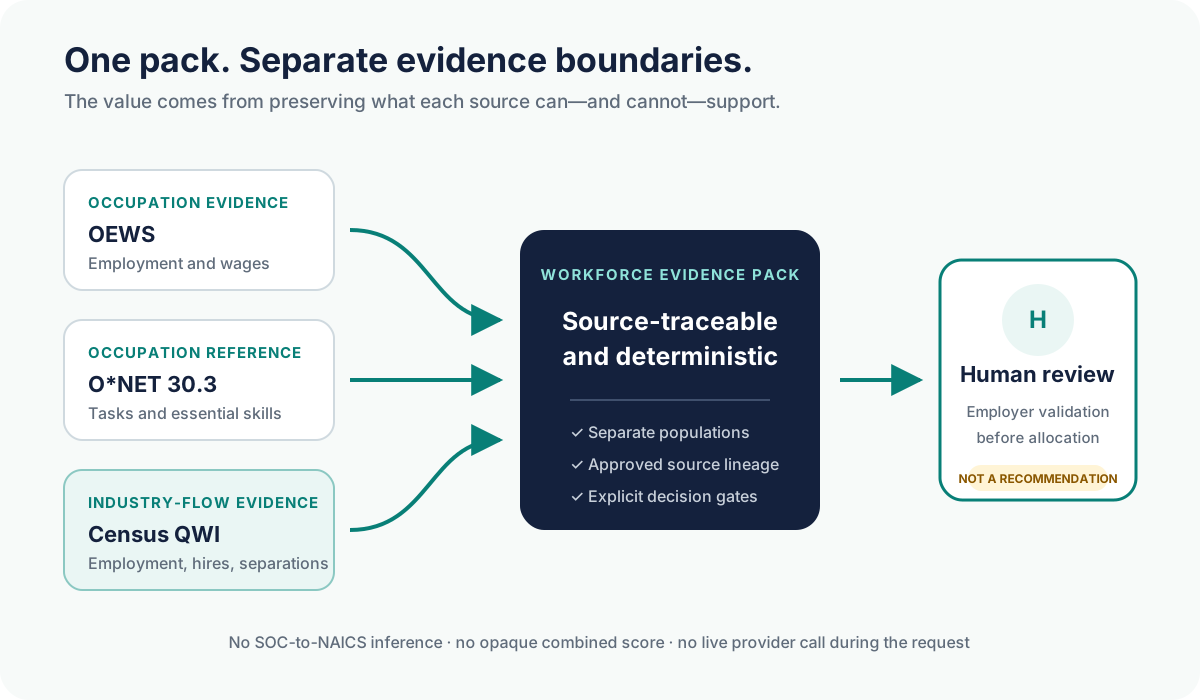
The sources are complementary, not interchangeable. SOC, ONET-SOC, and NAICS remain separate identifiers and evidence populations.*
This matters because an occupation can be large statewide while local employers have little near-term hiring need. An industry can show substantial hiring and separation flows without revealing which individual role caused them. A national occupation profile can describe typical work without capturing one facility’s tools, safety rules, or production process.
Combining those facts into one synthetic score would hide the gaps rather than resolve them.
Where statewide context ends
Section titled “Where statewide context ends”For a Central Texas decision, the most important missing evidence is local:
- the target counties or commuting area;
- employers prepared to validate the cohort;
- expected hiring or incumbent-worker need over the next 12–24 months;
- required entry skills, credentials, equipment, and safety conditions;
- available training providers, capacity, duration, and cost;
- the outcome that would justify public investment;
- the reviewer accountable for the final disposition.
The pack records these gaps instead of silently treating an empty field as approval.
That makes the statewide evidence useful without making it carry a claim it cannot support.
Evidence ownership is part of the decision
Section titled “Evidence ownership is part of the decision”Not every missing field belongs to the employer.
| Participant | Responsibility |
|---|---|
| AvelinLabs | Prepopulate available public and authorized market evidence with source, date, geography, and lineage |
| Employers | Confirm local hiring need and operational requirements |
| Training providers | Confirm program capacity, duration, cost, and expected outcomes |
| Program reviewer | Apply the program’s rules and record the final decision |
This ownership model changes the workshop from a blank questionnaire into a bounded review. Public and authorized evidence should arrive prepopulated. Human participants should confirm the facts and commitments that external data cannot observe reliably.
More feeds should reduce manual work—not remove validation
Section titled “More feeds should reduce manual work—not remove validation”The same structure can accept more localized evidence over time.
Metropolitan or nonmetropolitan OEWS data can provide a more relevant occupation baseline. QWI can be queried for counties, metropolitan areas, and workforce investment areas. Authorized job-posting evidence can add observed signals about vacancies, employers, skills, credentials, and recent trends. Provider datasets can add programs and completion evidence.
Those additions should reduce the number of blank fields presented to reviewers. They should not convert observed signals into employer-confirmed commitments.
A job posting, for example, may be duplicated, evergreen, routed through a staffing firm, or left online after a position changes. It is useful evidence. It is not the same as an employer confirming funded openings at a named facility.
The evidence state should remain visible:
- Observed — acquired from an approved source;
- Inferred — derived as a bounded hypothesis;
- Confirmed — validated by the responsible employer, provider, or program reviewer.
From cohort to decision
Section titled “From cohort to decision”The buyer-facing report condenses the cohort into a Decision validation matrix. For each occupation, it keeps five decision-facing questions visible:
- What is the program hypothesis, and what local evidence supports it?
- What hiring or incumbent-worker need has been confirmed?
- Is there a feasible training pathway?
- Which program rule applies?
- Should the role advance, remain on hold, or be removed?
Detailed geography, validators, reviewer, review date, and training fields remain available in the structured record.
The possible outcomes are deliberately simple:
- Advance — sufficient evidence exists to continue developing the investment case;
- Hold — the role remains plausible, but required evidence is missing;
- Remove — the need is not confirmed or the pathway is not viable.
The threshold is defined by the responsible program. AvelinLabs does not impose a universal employer count or silently transform missing evidence into a recommendation.
Why the API matters
Section titled “Why the API matters”The HTML report is designed for buyer review. The accompanying API response retains the complete structured evidence:
- full governed O*NET profiles and source lineage;
- occupation and industry observations kept separate;
- caller-supplied hypotheses and program rules identified as program context;
- complete validation records;
- deterministic identity and immutable retrieval;
- explicit evidence boundaries and decision readiness.
That separation keeps the report concise while making the underlying record available for applications, repeatable regional analyses, and audit.
The result is not an automated investment recommendation. It is a governed path from statewide context to a locally reviewable decision.
Localize the scenario
Section titled “Localize the scenario”To adapt this cohort, start with the target geography, participating employers, relevant training providers, and the program’s decision rules. AvelinLabs can then package the available evidence, identify what remains unconfirmed, and preserve the final review record.
Explore the Workforce Evidence Pack API or request evaluation access to apply the workflow to another region, industry, or occupation cohort.